
alpenscapes
firewise

Understanding Wildfire Risks to Your home
Fire doesn’t just threaten forests; it threatens homes, neighborhoods, and lives.
Most homes are not lost to a wall of flames. They are lost when embers ignite dry vegetation, mulch, decks, fences, or debris immediately adjacent to the home. Overgrown shrubs, low tree branches, and continuous vegetation create “ladder fuels” that allow fire to climb from the ground into the canopy.
Big Sky faces greater wildfire risk than 96% of communities in the United States.
Thoughtful landscape design plays a critical role in wildfire mitigation. Fire-safe plant selection, spacing, maintenance, and non-combustible zones near structures can significantly reduce risk and improve defensible space around homes.
ignition sources
How Homes Ignite in Wildfire
Homes are most often lost in wildfires when a structure ignites from one of three sources:
1. Embers
Wind-blown sparks can ignite dry vegetation, debris, roofs, or vents
2. Direct Flame Contact
Fire reaches the home through nearby vegetation or combustible materials.
3. Radiant Heat
Intense heat from nearby flames can ignite materials without direct contact.
While you may think direct flame contact is the primary cause of fires, embers are responsible for most home ignitions. They can ignite vegetation, mulch, decks, and other materials near a home—often long before the main firefront arrives. Embers often land in the same places that needles and leaves accumulate: roofs, gutters, decks, and porches. Embers can also enter buildings through vents, attics, gaps, or open windows.
defensible space
Creating defensible space is one of the most effective steps homeowners can take to reduce wildfire risk.
Defensible space begins at your home’s foundation and extends outward to the edges of your property. It helps slow or stop fire spread, protects homes from embers and radiant heat, and provides firefighters with safer conditions to defend structures.
Everything on your property, from landscaping and decks to fences and vehicles, can act as fuel. Thoughtful, fire-resistant landscaping reduces these risks while still allowing for attractive, functional outdoor spaces.
Home Ignition Zone & Landscape Zones
Following Firewise guidelines is one of the most effective ways to create defensible space. The Home Ignition Zone (HIZ) extends roughly 100–200 feet from your home, depending on surrounding conditions. The goal is to reduce flammable materials, properly space vegetation, and maintain a landscape that is lean, green, and well cared for.
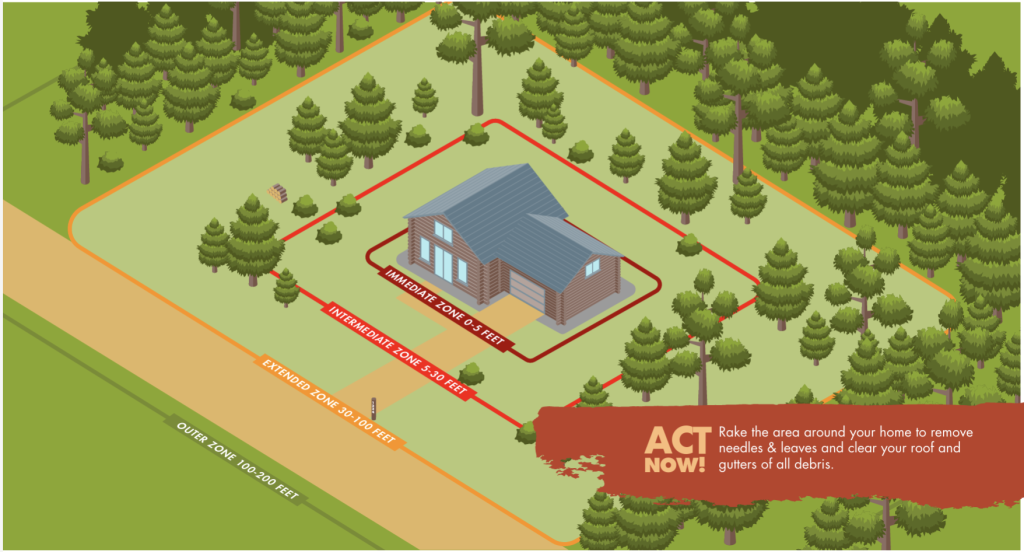
Image: Fire Adapted Montana, Montana Wildland Fire Preparedness Guide
integrated guidelines
Immediate Zone (0-5 feet)
This zone is the most critical area for protecting your home.
No flammable materials or vegetation should be placed within 0–5 feet of structures. This area should be reserved for non-combustible materials such as gravel, concrete, stone, or brick.
Design Guidelines
- Do not stack firewood or store combustible materials in this zone
- Use non-combustible surfaces whenever possible
- If gravel or hardscape is not feasible, use inorganic mulch only
- Do not plant trees, shrubs, or ornamental grasses in this zone
Routine Maintenance
- Keep the area clear of leaves, needles, and debris
- Regularly prune nearby vegetation to prevent encroachment
- Move anything that could burn away from the home
Local Requirement: Section 23.10 of the Gallatin County Big Sky Zoning Regulations requires a minimum of five (5) feet of fire-resistant ground cover around all exterior walls.
Intermediate Zone (5–30 feet)
This zone focuses on reducing fire spread and heat intensity near your home while still allowing for a functional, attractive landscape.
Design Guidelines
- Use low-growing, well-spaced, drought-tolerant plants that are regularly pruned to remain lean and green
- Prioritize native species that support ecological health, enhance biodiversity, and require less long-term maintenance
- Minimize lawn areas to reduce water use and limit turf to flat areas where irrigation is most efficient
- Use native shrub borders in narrow or hard-to-irrigate areas
- Add hardscape elements such as patios, gravel paths, boulders, and rock terrace gardens to break up vegetation and slopes
- Avoid unnecessary soil disturbance to reduce weed germination
- Use mulch to moderate soil temperature, retain moisture, and suppress weeds
Routine Maintenance
- Keep grass under 4 inches tall when fire danger is medium/high
- Prune tree branches 6–8 feet from the ground, or up to one-third of the tree’s height if the tree is under 15 feet tall
- Space tree crowns 18–20 feet apart, increasing spacing on steeper slopes
- Remove dead or dry plant material regularly
Extended Zone (30–100+ feet)
This zone focuses on fuel mitigation within existing landscapes, rather than formal garden design. The goal is to interrupt fire movement and prevent ground fires from spreading into the tree canopy.
Routine Maintenance
- Remove dead plant material and accumulated debris
- Prune shrubs and trees to eliminate ladder fuels
- Maintain spacing between plants to reduce fire intensity
- Monitor regularly for invasive weeds and manage new growth early
- For landowners with more acreage, consider overall health and thinning trees
consider your plant spacing
Maintain Spaces Between Plants
Proper spacing helps reduce fire spread, improve irrigation efficiency, and support healthier plant growth.
Tree Spacing
Spacing depends on the Home Ignition Zone. Keep branches at least 10 feet from structures. In the intermediate zone, 18 feet between crowns is recommended.
Shrub Spacing
Maintain at least 5 feet between shrub groupings, adjusting for mature size and growth habit.
Vertical Spacing
Prune tree branches to create a clearance of 6 to 8 feet from the ground to prevent ground fires from climbing into tree canopies.
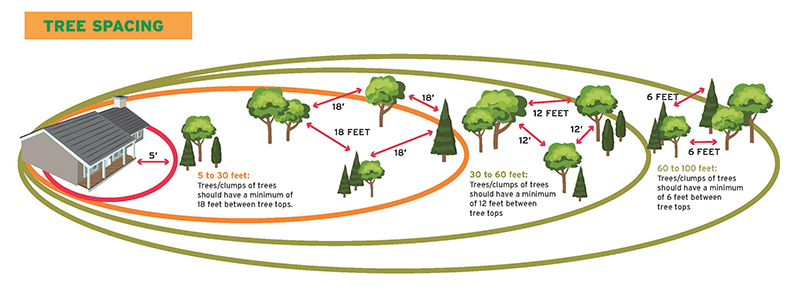
Photo: National Fire Protection Association
For details on specific spacing between plants, download the Alpenscapes Landscaping Guidelines.
putting it all together
Firewise, Water-Efficient, and Native-Centric
We understand that being firewise might be a top priority for you, but it’s important to know that focusing on wildfire risk reduction does not mean giving up on having a beautiful, water-wise, native plant-filled landscape.
Many native species are naturally adapted to local conditions, support healthy soils, and, when thoughtfully selected and maintained, can reduce fire risk rather than increase it.